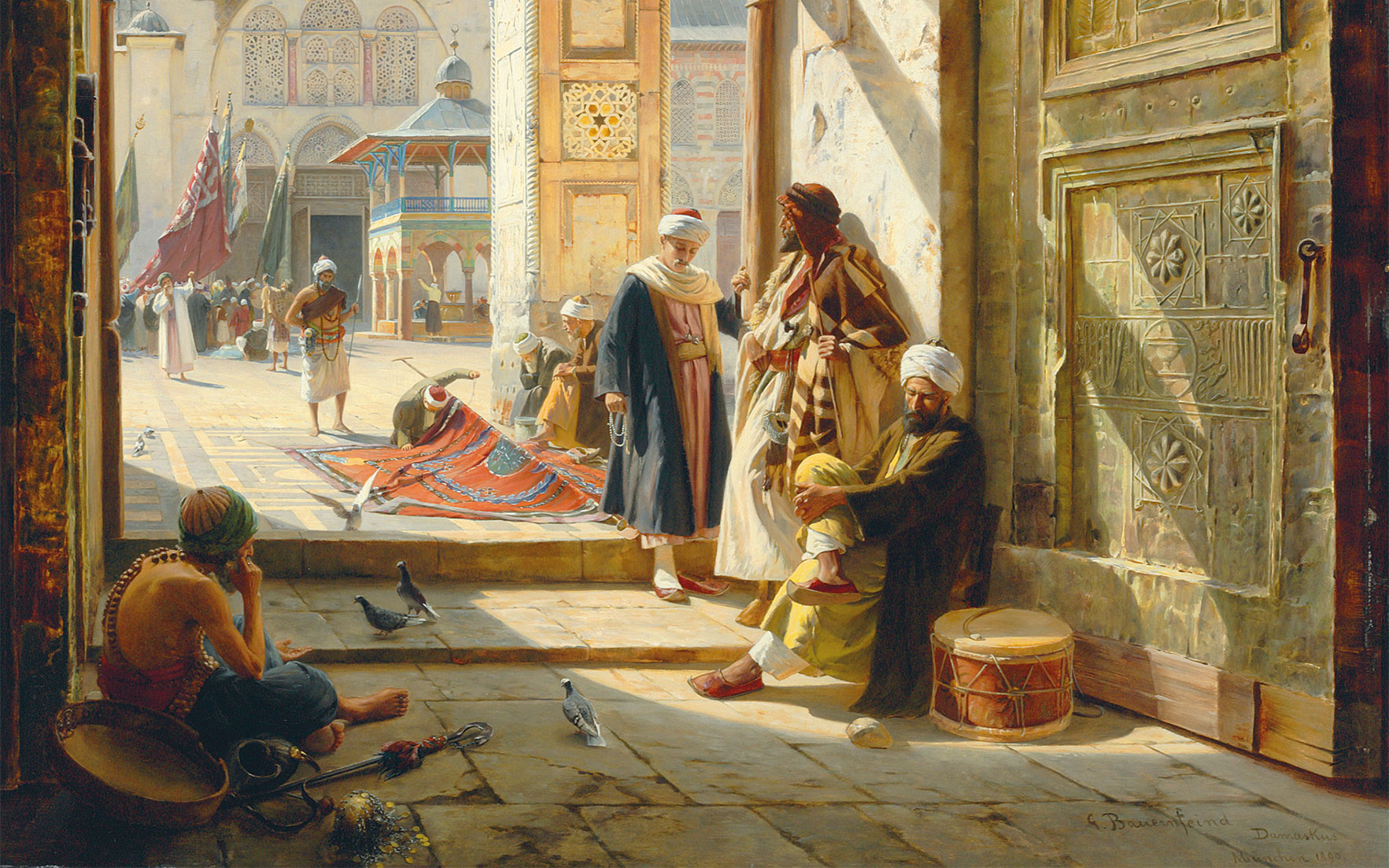
Gustav Bauernfeind (German, 1848-1904), detail from The Gate of the Great Umayyad Mosque, Damascus, 1890. Oil on panel. 47⅝ x 38 in (121 x 96.5 cm). Sold for £2,505,250 on 2 July 2008 at Christie’s in London.
Readings
Edward Said, Orientalism (New York: Vintage Books, 1978), (pp. 1-9).
Zach Lockman, “Introduction” and “Chapter 6: Said’s Orientalism: a book and its aftermath,” Contending Visions of the Middle East: The History and Politics of Orientalism, Second Edition (Cambridge: Cambridge UP, 2010): 1-7; 183-191 [read until “Bernard Lewis Responds” section].
James Gelvin, “Chapter 1: Before the Deluge” and “Chapter 2: The Arab Uprisings and their Fallout,” The New Middle East: What Everyone Needs to Know (Oxford: Oxford UP, 2017), 1-50.
Eric Davis, “10 Conceptual Sins,” http://new-middle-east.blogspot.com/2009/01/10-conceptual-sins-in-analyzing-middle.html.
Optional
Jeremy Adelman, “What is global history now?” Aeon (March 02, 2017) https://aeon.co/essays/is-global-history-still-possible-or-has-it-had-its-moment.
Cyrus Schayegh, “On Scales and Spaces: Reading Gottlieb Schumacher’s The Jaulan (1888),” in Liat Kozma, Cyrus Schayegh, and Avner Wishnitzer (eds.) A global Middle East : mobility, materiality and culture in the modern age, 1880-1940 (London: IB Tauris, 2015), 19-55.
Lila Abu-Lughod, "Do Muslim women really need saving? Anthropological reflections on cultural relativism and its others," American anthropologist 104.3 (2002): 783-790.
Sunaina Maira, "Belly dancing: Arab-face, Orientalist feminism, and US empire," American Quarterly 60.2 (2008): 317-345.
In-Class
Lecture Powerpoint
Primary Source Exercise (Breakout Room 1 and 2)
"Remember the Time," Michael Jackson, 1991.
"This is Egypt," Egyptian Ministry of Tourism, 2016.

Orientalism, coined by Edward Said, a Palestinian intellect, is a flawed way of understanding the Eastern Hemisphere, including Asians and Arabs. The term was coined during the 19 century. Orientalism has been around since the time when the Arab world was being colonized and Europe was going through Enlightenment. Said analyzed how the Western scholars and historians could not understand the various Eastern cultures because of how different they were from the Western culture. With Arab culture and Asian cultures, Westerners perceive it as being something exotic, backward, uncivilized, and even dangerous. Last semester, I ventured to the British Museum’s Islamic gallery with my Islamic class in order to get a better understanding of Orientalism and its presence in the West today. The location of the Islamic gallery highlights the theme of Orientalism. Previously, the vast collection had been squashed into a couple of small rooms at the back end of the building with the artifacts isolated in restrictive rooms in the Northern section. This emphasized how the West thought of Islam as being inferior compared to them, putting very little importance on their artifacts compared to Western galleries. Thankfully, since then, the British Museum's Albukhary Foundation has moved it through their donations so that it could be a part of conversation. Moreover, this is the only gallery within the British Museum named after a religion and not a geographical location. This is a way of characterizing all Muslims as being the same and regarding Islam as a culture when it is a religion. These concepts are all a part of Orientalism and it is crucial to clear these misunderstandings.
ReplyDeletegood response thinking through orientalism in a present-day context. it's especially relevant because orientalism continually manifests itself in cultural production of european/american institutions. for future blog posts, i would like you to refer to more than one reading and synthesize your response i.e. compare the themes and arguments of the readings and point out patterns, as well as note a keyword/key concept with a quotation as i mention on the syllabus. finally, please sign your name to each blog post (above or below your response is fine) so i know who is responding. thanks.
DeleteWill def. do that for the next response! Sorry, I thought my name appeared as I replied through my nyy email. It's Aya.
DeleteHadley:
ReplyDeleteThe concept and implications of “Orientalism” are dissected in the readings from Said, Lockman and Davis. All authors work to rectify the damaging implications created by the idea that is Orientalism, a notion invented by the West, or the Orient’s antithesis, the Occident. As Said and Lockman point out, the ideas of the Orient and Orientalism stem from Western ideologies surrounding the Middle East, and are the product of racially motivated Othering. In order to control and dominate the Middle East, Colonial powers had to separate the Middle East from themselves, birthing the Occident in response to the fabricated notion of the Orient, in a ploy to gain dominance over the people and products within. Creating narratives and false discourses that have been hegemonically instilled into global, and specifically Western beliefs surrounding the Middle East, have helped sustain principles of European superiority and Middle Eastern backwardness. The “Us vs. Them” mentality is so alive and well in contemporary political and social thought that Eric Davis’ 2009 blog post about the dangerous stereotypes, misinformation, and generalizations Westerners make about the Middle East and its people is still relevant 11 years later. When thinking about the Middle East, especially from my own perspective (that is, someone raised in the United States with limited knowledge about the complexities of the Middle East) it is important to remember the dangers of a single story, as Chimamanda Adichie's TEDTalk warns. In order to dismantle the various biases that exist within myself and the world around me about the “Orient,” I have to understand the different structures that support and spread those ideas, Orientalism, being one of the strongest ideologies to do so.
great response hadley. i really liked when you link the global and 'Western' here: "Creating narratives and false discourses that have been hegemonically instilled into global, and specifically Western beliefs surrounding the Middle East..." it's important to note that much of what we believe are larger, global conceptions of places, peoples, and cultures are intrinsically eurocentric (i.e. stemming from european thought)
DeleteIn the introduction to his book “Orientalism”, Edward Said defines Orientalism as “a way of coming to terms with the Orient that is based on the Orient’s special place in European Western experience”. By this, he means that Orientalism has provoked an all-around worldview that the West has manifested that promotes that the West is superior to the East. This is also brought up in the Lockman reading, as he agrees that this opinion has expanded into a worldview. Both readings promote the idea that gaining knowledge and a greater understanding of the East is the most effective way of putting an end to the misinterpretation and stereotyping of the East; although Said does this in a more theoretical way whereas Lockman does this in a more history-based, explanatory way, both authors have the main goal of spreading awareness of the true history of the East to end the negative connotation of the words “orient”, “oriental”, and “orientalism”. What I found interesting about reading these various readings at the same time was how consistent this struggle is. “Orientalism” from 1978 tackles similar issues that are brought up in the 2009 “10 Conceptual Sins” blog post. Although I do feel that as history becomes more widespread these issues are getting better, it did upset me to think about the fact that so many of these problems have not dissipated despite the work done by authors like those we read this week. Some of the “sins” from the blog post are the same issues that were brought up in Said’s piece, such as the “excessive focus on elites”. Although they tackle these in different ways, both pieces discuss the idea that history is ‘told by winners’. Again, they both promote this idea that becoming educated on the subject is the most valuable way of understanding history and putting an end to stereotypes. Another sin that was brought up was the “failure to learn the history, language, and cultures of the region”, which directly addresses that problem as well. Lastly, I found the “why can’t they be like us?” sin to be all encompassing of the bigger picture problem here. Psychologically, human beings like to stick to what they know and not reach far out of their comfort zone. In doing so, historically the West tells history from a perspective of “us” vs the “other”. To me, this is the base line problem that has caused a snowball effect for various stereotypes throughout humanity. Once we stop thinking “why can’t they be like us?”, and start thinking about how we are all one human race, we can begin to mend the cracks that the West has left in the Western view of Eastern history.
ReplyDelete--
Diva
diva, you do well to bring up the idea that orientalism is a longstanding phenomenon with relevance today, and i'd add especially after 9/11 (when US, and therefore global, attention and engagement with the middle east became even more entrenched in the sins of orientalism).
Delete
ReplyDeleteEdward Said refers to Orientalism as the study and analysis of the East from the perspective of the West. Any commentary on the Middle East and its varying nationalities, ethnic groups and histories which chooses to tackle the region as one monolith deemed the “Orient” is regarded as Orientalism. This idea is then contrasted with another arbitrary idea of the West/Occident, ignoring the nuances within both labels, turning the story black and white. Regarding the West, he specifically explores the ways in which France, Britain and the United States exercise Orientalist thought as a means of power and dominance. Said highlights an encounter between Kuchuk Hanem, an Egyptian woman and French author Gustave Flaubert from the perspective of Flaubert. He explains how Flaubert describes Hanem from his sole perspective, speaking from a position of power, he chose to depict her in typical oriental fashion. Said states this is not an isolated event.
This rang true to me, the idea that western media, news and narratives often portray what they call the "Orient", all while never considering the opinion or perspective of those they write these narratives about. Instead those writing these stories choose to solely rely on their understanding of the topic. Western media has taken upon itself to generalize those who identify as Arab and especially Muslim as people fundamentally against the West, never exploring the deeper nuances and relationships at hand. Orientalism has many believing that the Orient is one monolith, when in fact, different nations, people and political parties across the Middle East have varying opinions on Europe, the US and the west in general, independent of their religious ties or "Arabness".
There are many examples of Western media making blanket statements and narratives revolving the Middle East, most notably how they choose to cover Islam, a topic extensively covered by Said. As a result of Orientalism characterizing what is in fact a complex melting pot of varying ethno groups, religions and cultures all under the same label, errors in the orientalist’s analysis is bound to occur. Not having a deeper understanding of your topic of study is bound to result in errors, something I was reminded of by a meme circulating the web as of recently. The show ‘9-1-1 Lone Star’ portrayed a Muslim Firefighter as she did her prayer before work. However, the prayer was carried out completely wrong breaking basic rules many Muslims know to follow when praying. This was a clear example of media not exploring the deeper levels of the narratives they wrote, often choosing to simplify Middle Eastern narratives, satisfying the definition of Orientalism.
Mostafa
mostafa, i like the connection you make between said's example of kuchuk hanem and present-day western media narratives around the middle east. the longevity of orientalism is clear from these examples and from the 9-1-1 lone star reference you make. an important further step is to break down 'western media' - which itself is not a monolith - and think about how different players, be they news media conglomerates, 'independent' journalists, TV show writers and producers, etc., imagine and project a different middle east according to the narratives they seek to promote.
DeleteSaif Al Saif , May 28
ReplyDeleteThe reading for this class were very interesting and intuitive for me. The discussion varies from the ideological relationship between the west and the east, to a detailed explanation of the history, economy and politics of the Middle East and North Africa (MENA) region.
Orientalism by Edward Said, was a hard reading to be honest. What I grasped from the text is that Edward Said explained the academic meaning of orientalism, which is “a style of thought based on an ontological and epistemological distinction between ‘the Orient’ and (most of the time) the Occident.” He explained an imaginary meaning or context for orientalism, which is two different civilizations between the West and East that the west cannot study or understand certain cultures that the East must have. He also gave another meaning that gave a third meaning for orientalism that came or was seen after the 19th century and it is “Orientalism can be discussed and analyzed as the corporate institution for dealing with the Orient – dealing with it by making statements about it, authorizing views of it, describing it, by teaching it, settling it, ruling over it: in short, Orientalism as a Western style for dominating, restructuring, and having authority over the Orient.”
Zackary Lockman, gave a detailed analysis of the ways and the buildup of Edward Said’s argument. He explained how Edward sourced or used Foucault’s thoughts on the formation of knowledge and the association with power and believed that orientalism is a form of knowledge that is exercised with the holding of power that the West is having.
What I liked between the two texts is that they, gave an explanation of how orientalism was exercised by the Europeans and how did the American exercised it before and after their rise. It is also important to understand the connection between the post and after period of the European Colonization and how did it affect orientalism. In my opinion, in the state of colonization there were two views of understanding the views of the west to east. The western who lived on those colonized eastern states would have a better understanding of the ideology and the culture that those eastern colonized states would follow. The other view, is that westerns who lived in those eastern colonization would have a feeling of superiority that would even increase the gap of the relationship between the knowledge of the western’s and the eastern.
As for the other readings, it was heavily integrated between the history, economy and politics of the MENA region. I could also see that there was significant interference of the west in certain ideological and human rights cases in the MENA region. Which is interesting because combining the pervious readings with the states of the MENA region, one could ask: why does Western superiors countries tend to interfere in certain countries? Do they see them self’s as better that those counties?
I would also like to see how does the East think of the West and how would the rise of China could affect all of this.
saif, you did a great job breaking down some of the ways said defines orientalism. it's easy to forget that there are multiple vectors by which orientalism manifests itself, and they are not necessarily easily identifiable. you also pointed out something important which we also later discussed in class, which is that there is an important distinction to be made between european and american orientalism. we haven't gotten into this but the power dynamics within each are necessarily different due to historical context, but i'm glad you caught on to this from the readings.
DeleteThis comment has been removed by the author.
ReplyDeleteThis comment has been removed by the author.
DeleteThis comment has been removed by the author.
Delete